Healthcare AI on AWS: Architecture, Security, and Compliance Best Practices
Where Innovation Meets Compliance
The Real Challenge with Healthcare AI
summarize clinical notes, and assist in decision-making. But building the model is not the hardest part anymore.
The real challenge is building systems that:
- Clinicians trust in real time
- Organizations can defend during audits
- Regulators can validate without friction
In healthcare, AI must go beyond intelligence. It must be:
- Traceable
- Secure
- Compliant by design
- Seamlessly integrated into workflows
Many initiatives fail—not because AI is weak, but because the system around it is not designed for healthcare realities.
Why Healthcare AI Needs a Different Approach
Healthcare operates under strict clinical and regulatory expectations.
A single AI-driven suggestion can impact:
- Patient outcomes
- Provider decisions
- Compliance audits
This requires:
- Explainable decisions
- Auditable interactions
- Controlled data flows
AI is not just a feature—it becomes part of a clinical decision-support system
A Practical Architecture for Healthcare AI on AWS
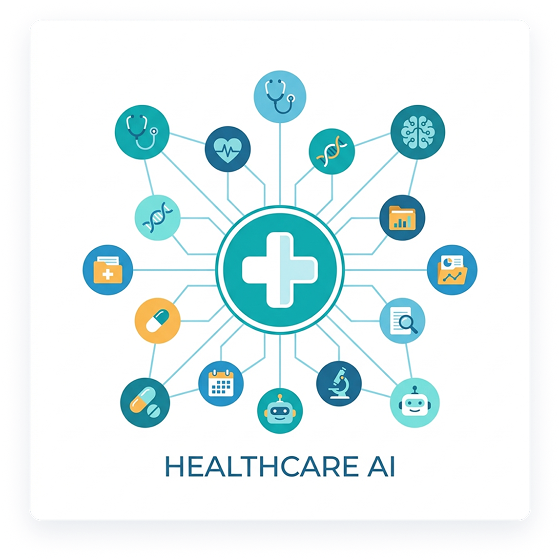
A layered architecture helps address real-world challenges effectively.
Isolate PHI from EHRs, labs & external systems at the boundary.
Healthcare data comes from EHRs, labs, and external systems.
- Identify and isolate PHI
- Pass only relevant data
- Support real-time and batch ingestion
Security and compliance begin here.
Structure data so AI understands patient history and care settings.
AI must understand:
- Current patient encounter
- Active vs historical conditions
- Care setting and timeline
This ensures outputs are clinically relevant.
Predictive & generative AI with guardrails — not every output is shown.
AWS enables predictive and generative AI. However:
- Not every request should reach the model
- Not every output should be shown
- Not every decision should be automated
The focus is controlled intelligence, not unrestricted automation.
The system's control center — applying policies and triggering human oversight.
This layer acts as the system's control center.
- Applies clinical and compliance policies
- Coordinates models and workflows
- Triggers human intervention when needed
In simple terms, it ensures AI follows rules and produces safe outcomes.
Critical for Generative AI: risks like hallucinations must be controlled before reaching clinicians.
Immutable audit trail: data used, model version, logic, and provider action.
For every AI output, systems should capture:
- Data used
- Model version
- Decision logic
- Provider action
This enables full traceability during audits.
AI insights surface inside EHR screens — providers accept, edit, or override.
AI must fit into existing systems.
- Insights appear within EHR screens
- Providers can accept, edit, or override
- Feedback improves future outputs
The goal: support clinicians without slowing them down.
Security in Healthcare AI
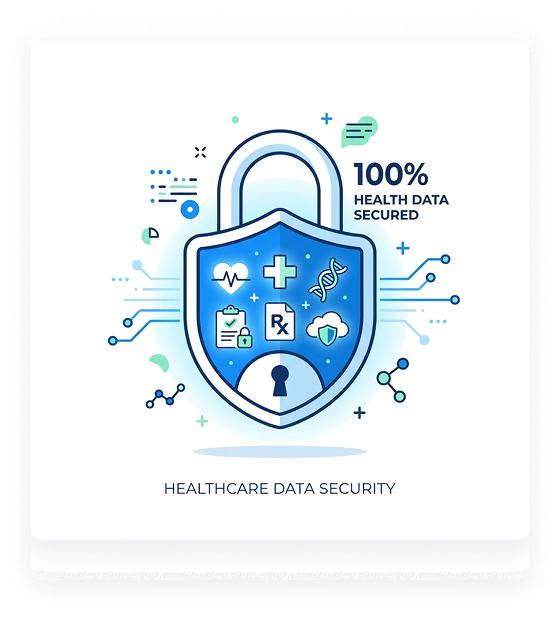
Security is about control—not just encryption.
Key principles:
- PHI isolation and access control
- Inference protection to prevent data exposure
- Runtime monitoring of AI behavior
A secure system ensures responsible data usage.
Compliance as a System Behavior
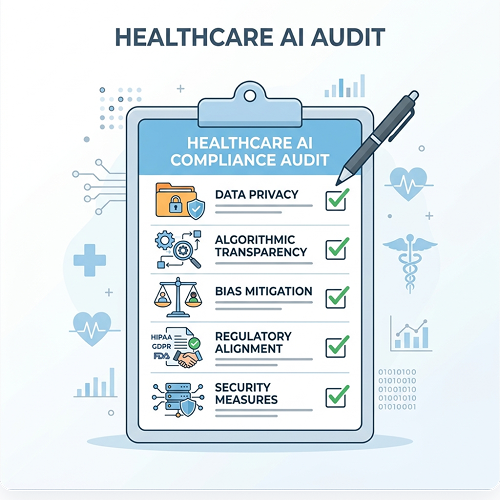
Compliance should be built into the system.
- Every interaction is logged
- Model versions are linked to decisions
- Human overrides are tracked
- Policies are enforced in real time
This makes compliance a natural outcome—not a manual effort.
Real-World Use Cases
AI analyzes history and vitals, flagging risks and reducing documentation time.
During a patient visit:
- AI analyzes history and vitals
- Flags potential risks>
- Validates outputs using clinical rules
- Provider reviews and acts
Impact: Up to 25–30% reduction in documentation time and improved audit readiness.
AI processes data to support claim validation, speeding up processing time.
In operations:
- AI processes structured and unstructured data
- Supports claim validation and order tracking
- Routes complex cases to humans
- Maintains a full decision trail
Impact: 15–20% faster processing with maintained compliance.
Common Pitfalls to Avoid
- Treating AI as a standalone feature
- Ignoring clinical context
- Adding compliance after deployment
- Missing audit trails
- Not planning fallback mechanisms
A governed architecture avoids these issues from the start.
Enabling Success with the Right Expertise
Building healthcare AI requires:
- Cloud architecture
- Data engineering
- Security design
- Regulatory understanding
Organizations often partner with experts to bring these together.
With capabilities across AI, Data, Cloud, and Digital transformation, companies like Youngsoft help design solutions that are intelligent, secure, scalable, and compliant.
Conclusion: Building AI That Healthcare Can Trust
Healthcare needs responsible AI systems, not just smarter models.
Systems that:
- Fit into clinical workflows
- Protect sensitive data
- Provide explainable decisions
- Meet compliance requirements
AWS provides the foundation. Strong architecture and governance bring it to life.
The next step is clear: Design for trust, build for compliance, and scale AI with confidence.